The jump to senior changes your day more than your job title suggests. As a mid-level engineer, success mostly meant shipping your own tickets. As a senior, you're still expected to ship, but you're also the person others come to for reviews, design decisions, production issues and "quick questions" that are rarely quick.
Without a deliberate routine, those interruptions eat the whole day, and the hard technical work that only you can do gets pushed into evenings. This guide covers a structure that keeps both sides of the job healthy.
What a Senior Engineer's Time Actually Goes To
Before planning your day, be honest about where the time goes. For most senior engineers it's a mix of:
| Activity | What it looks like |
|---|---|
| Deep work | Designing and building the hardest parts of a feature, refactoring, performance work |
| Unblocking others | Code reviews, answering questions, pairing, debugging with a teammate |
| Planning and design | Writing technical designs, estimating, reviewing requirements with product |
| Communication | Stand-ups, status updates, client or stakeholder discussions |
| Operations | Investigating production issues, on-call, release support |
| Growth | Learning new tools, reading, mentoring, improving team processes |
None of these is optional at the senior level. The goal isn't to eliminate any of them; it's to stop them from fighting each other.
Tip
Track your time loosely for one week: just a note every hour of what you actually did. Most engineers are surprised by how fragmented their days are, and that data makes the rest of this guide much easier to apply.
Step 1: Protect a Daily Deep-Work Block
Complex engineering work needs long, uninterrupted stretches. A 30-minute gap between two meetings is enough to answer a review, but not enough to reason about a tricky concurrency bug or design an API.
Pick a two- to three-hour block, ideally at the time of day you think most clearly, and defend it:
- Put it on your calendar as a real event so people can't book over it.
- Close chat and email, or set your status to "focusing, back at 11:30".
- Decide the task the night before, so you don't spend the first 20 minutes choosing what to do.
Mornings work well for many people because fewer meetings have started, but the right slot is whichever one you can protect consistently.
Step 2: Batch Code Reviews and Questions
Reviews and questions are your highest-leverage work as a senior: one good review can save hours of rework. But handling each notification the moment it arrives destroys focus.
Instead, set two or three review windows per day, for example after stand-up, after lunch and late afternoon. Teammates quickly learn that they'll get a response within a few hours, which is fast enough for almost everything.
Note
Make one exception: a teammate who is completely blocked, or a production issue. Agree with your team on how to flag those (a direct mention, a dedicated channel) so true emergencies still get through.
Step 3: Run Meetings Like Code
Meetings aren't the enemy; unclear meetings are. Treat them with the same care you'd give a pull request:
- No agenda, no meeting. If there's nothing specific to decide or discuss, an async update is enough.
- Stack meetings together instead of scattering them, so the rest of the day has usable blocks.
- End with decisions and owners. "Who does what by when" should be written down before everyone leaves.
- Decline politely when you're not needed, and ask for the notes instead.
Step 4: Plan the Week, Not Just the Day
A daily to-do list keeps you busy; a weekly plan keeps you effective. Spend 20 minutes at the start of each week on three questions:
- What's the one most important outcome this week? A feature shipped, a design approved, a risky migration done.
- What could block it? Missing requirements, dependencies on another team, an unanswered question.
- Who on the team needs my help this week? A review that's waiting, a junior developer stuck on a new codebase.
Then put the important outcome into your deep-work blocks first, before the week fills up with other people's priorities.
Step 5: Write Things Down
A large part of seniority is reducing how often people need you to be in the room. Writing is how you scale yourself:
- Design docs before big changes, so decisions are reviewed early and remembered later.
- Short decision records ("we chose X over Y because…") in the repo or wiki.
- Runbooks for production issues you've fixed, so the next person can fix them without you.
- Clear pull request descriptions explaining why, not just what.
Every question your documentation answers is an interruption that never happens.
Step 6: End the Day on Purpose
The last 15 minutes of the day set up the next one:
- Leave yourself a note about exactly where you stopped and what the next step is.
- Clear or reply to anything blocking a teammate, so they can start tomorrow without you.
- Update the ticket or status so nobody has to ask where things stand.
- Pick tomorrow's deep-work task.
Then actually stop. Senior engineering is a long game, and consistent, rested focus beats occasional late-night heroics.
A Sample Day
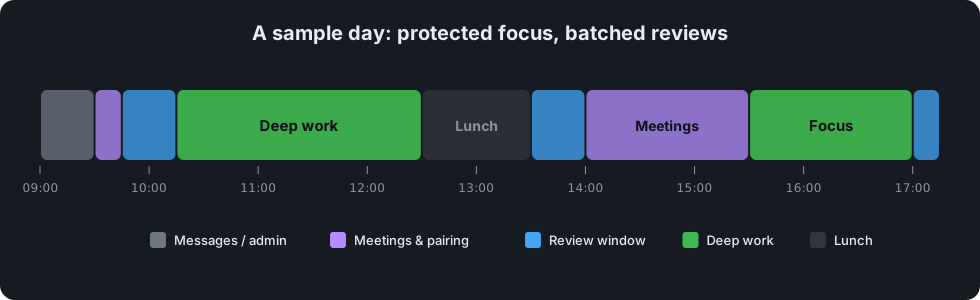
Here's what this can look like in practice. Adjust the times to your team and time zone:
| Time | Focus |
|---|---|
| 09:00 – 09:30 | Check messages, review the plan for the day |
| 09:30 – 09:45 | Stand-up |
| 09:45 – 10:15 | Review window 1: pull requests and questions |
| 10:15 – 12:30 | Deep work (notifications off) |
| 12:30 – 13:30 | Lunch, away from the screen |
| 13:30 – 14:00 | Review window 2 |
| 14:00 – 15:30 | Meetings, design discussions, pairing or mentoring |
| 15:30 – 17:00 | Second focus block or smaller tasks |
| 17:00 – 17:15 | Review window 3, end-of-day notes, plan tomorrow |
Warning
Don't aim for a perfect schedule every day. Production incidents and urgent requests will happen. The routine is the default you return to, not a rule to feel guilty about breaking.
Summary
The best senior engineers aren't the ones who write the most code or attend the most meetings. They protect time for hard technical work, make themselves easy to get help from at predictable times, and write things down so the team doesn't depend on them for every answer. Start with one protected deep-work block and batched reviews; those two changes alone make a noticeable difference within a week.